Japan's Qualified Invoice System in 2026: A Freelancer's Complete Guide Before the October Transition
What Is Japan's Qualified Invoice System?
Japan's Qualified Invoice System is a way of recording sales and consumption tax. It started on October 1, 2023, and it mainly matters to businesses that charge or claim consumption tax.
For freelancers, the basic idea is simple. A qualified invoice shows important details about a sale, including the seller's registration number, the applicable tax rate, and the amount of consumption tax.
If you're working with Japanese businesses, your client may ask whether you can issue a qualified invoice. That's because businesses may need these invoices to support their consumption tax records.
But being a freelancer doesn't automatically mean you have to register. Whether registration makes sense depends on your business, your clients, and your tax situation.
With the Japan Qualified Invoice System, the most important thing is to understand how it affects your own work before deciding whether to register.
Does a Freelancer in Japan Need to Register?
Not every freelancer in Japan needs to register for the Qualified Invoice System. This is probably the first thing you should know before filling out any registration form.
If you're a tax-exempt business, you can generally remain tax-exempt. However, your business clients may prefer to work with a freelancer who can issue qualified invoices because of how they handle their own consumption tax.
This is where your type of client matters. If most of your work comes from companies in Japan, they may ask for a qualified invoice. If you mainly work with individual customers, the situation can be quite different.
Registering also means you become a taxable business operator for consumption tax purposes. So don't register simply because another freelancer told you that you “need to.” Look at your clients, your income, and your business plans first.
The qualified invoice system for freelancers in Japan is something you should decide based on your own situation, not a one-size-fits-all rule.
What Is a Qualified Invoice Issuer?
A qualified invoice issuer is a business or freelancer that has registered with Japan's tax authority and is allowed to issue qualified invoices.
Once you're registered, you'll receive a registration number. You'll need to include this number on your qualified invoices, along with other required invoice details.
Why does this matter? Your business clients may need a qualified invoice when they work out their own consumption tax. So if you regularly work with Japanese companies, a client may ask you for your registration number before hiring you.
But registration isn't something you should do without thinking about the tax side. Becoming a qualified invoice issuer means you're treated as a taxable business operator for consumption tax purposes.
So, before becoming a qualified invoice issuer, check what registration means for your business and whether your clients actually need qualified invoices from you.
What Information Must Be on a Qualified Invoice?
A qualified invoice doesn't need to look complicated. What matters is that it includes the information required by Japan's tax rules.
For a freelancer, the main details include:
Your name or business name and registration number
Transaction date
What you provided — for example, website design, writing, or consulting
Total amount for each tax rate
Applicable consumption tax rate
Consumption tax amount for each tax rate
Your client's name or business name
Japan has different consumption tax rates, so the invoice should clearly show which rate applies to the transaction. The National Tax Agency lists these details as the required items for a qualified invoice.
You don't need to use a special invoice design. A document can qualify as an invoice as long as it contains the required information.
So, when preparing an invoice under the Japan invoice system 2026, don't focus too much on making it fancy. Focus on getting the required details and tax amounts right.
What Is the Invoice Registration Number in Japan?
The invoice registration number is a unique number given to a business or freelancer after registering as a qualified invoice issuer. You'll use this number on your qualified invoices.
For a business, the number starts with the letter “T” followed by 13 digits. For example, it may look like:
T1234567890123
That's only an example, not a real registration number.
Your clients can use the number to check whether you're registered as a qualified invoice issuer. That's especially useful when you're working with Japanese companies that need to keep proper consumption tax records.
If you've registered, make sure the number on your invoice is correct. One wrong digit can create unnecessary questions from your client.
When preparing a qualified invoice in Japan, treat your registration number like an important business detail. Check it before sending every invoice, especially if you're using a new invoice template.
What's Changing on October 1, 2026?
October 1, 2026 is an important date for Japan's Qualified Invoice System because one of the temporary rules changes on that day.
If a business buys from a seller who isn't a qualified invoice issuer, the buyer may still be able to claim part of the purchase tax credit during the transition period. Until September 30, 2026, the temporary rate is 80%. From October 1, 2026, it drops to 50%. This 50% rule is scheduled to apply until September 30, 2029.
Here's a simple example. If a Japanese company buys a service from a freelancer who isn't registered, the company may get a smaller tax credit under the new 50% transition rule than it could before October 2026.
This doesn't mean every freelancer must register. It means the change may make registration more important for some freelancers, especially those who work mainly with businesses.
If you're affected by the Japan Qualified Invoice System October 2026 change, check your client relationships and tax situation before making a decision.
What Does the October 2026 Change Mean for Freelancers?
Create Professional Invoices with Invoice Desire
Create your next invoice with Invoice Desire and make billing easier.
The October 2026 change doesn't mean every freelancer suddenly has to register. What it does mean is that some business clients may pay more attention to whether their freelancers can issue qualified invoices.
If You're Already Registered
If you're already a qualified invoice issuer, there isn't a new registration step just because October arrives. Keep using your registration number on your invoices and make sure your invoice details are correct.
If You're Not Registered
This is where you should look at your own clients. If you mainly work with Japanese companies, a client may prefer a registered freelancer because of the way they handle their consumption tax.
From October 1, 2026, the temporary purchase-tax-credit rate for purchases from non-qualified invoice issuers falls from 80% to 50%.
That could make some business clients more likely to ask freelancers about registration.
Still, don't register just because you heard that the rules are changing. Registration also means taking on consumption tax obligations. Look at your clients, your income, and your future plans first.
The Japan invoice system 2026 changes are worth understanding, but the right choice can be different for every freelancer.
Should a Freelancer Register for the Qualified Invoice System?
There's no simple “yes” or “no” answer here. For some freelancers, registering may make sense. For others, staying tax-exempt may be the better choice.
Start with your clients. If most of your work comes from Japanese companies, ask yourself whether they expect you to issue qualified invoices. If they do, registration could make it easier to keep those business relationships.
On the other hand, if you mainly work with individual customers, registration may be less important. Your clients may not need qualified invoices for their own consumption tax records.
You also need to think about the tax side. When you register as a qualified invoice issuer, you're choosing to become a taxable business operator for consumption tax purposes. The National Tax Agency explains that a tax-exempt business that registers becomes subject to consumption tax.
So before you register, look at:
Who your clients areWhether they ask for qualified invoicesHow much you earnHow much of your work is for businessesYour future plans
The qualified invoice system for freelancers in Japan isn't something you should decide based on what another freelancer is doing. Look at your own numbers and clients first.
How to Register as a Qualified Invoice Issuer
If you've decided that registration makes sense for your freelance business, the process starts with an application to Japan's tax authority. You can also use the e-Tax system to submit the application online.
The basic process looks like this:
1. Check your situation first. Make sure you understand what becoming a taxable business operator means for you.
2. Prepare your business details. You'll need the information required for the registration application.
3. Submit the application. You can apply through e-Tax or use the appropriate registration form.
4. Wait for your registration. Once approved, you'll receive your registration number.
5. Update your invoices. Add your registration number and the other required details to your qualified invoices.
6. Keep your records. Save your invoices and related business records properly.
The National Tax Agency provides registration information and application procedures for businesses that want to become qualified invoice issuers.
If you're searching for how to register for qualified invoice Japan, don't rush through the application just to get a registration number. First make sure registration actually fits your freelance business and that you understand the tax obligations that come with it.
Simple Qualified Invoice Example for a Freelancer
A simple example makes the Japan Qualified Invoice System much easier to understand. Here's what a freelance invoice could look like.
QUALIFIED INVOICE
Freelancer: Sakura Web Studio
Registration Number: T1234567890123
Invoice Date: August 19, 2026
Client: ABC Design Co., Ltd.
Service: Website design and setup — ¥100,000
Consumption Tax Rate: 10%
Consumption Tax: ¥10,000
Total: ¥110,000
This example shows the basic information a client needs to understand the charge. It identifies the freelancer, shows the registration number, gives the invoice date, describes the service, and shows the applicable tax rate and tax amount.
The name and registration number above are fictional examples. Don't copy them onto a real invoice.
When creating a qualified invoice in Japan, keep the layout simple. Your client shouldn't have to search around the page to find the amount, tax rate, or registration number. A clear invoice is easier for everyone to check and keep for their records.
Common Mistakes Freelancers Should Avoid
The Qualified Invoice System can look complicated at first, but many invoice problems come from simple mistakes. A quick check before sending your invoice can save you and your client a lot of trouble.
Using the Wrong Registration Number
If you're registered, check that your registration number is correct. Don't copy an old number or type it from memory.
Forgetting the Tax Rate
Your invoice should clearly show the applicable consumption tax rate and the related tax amount.
Using an Old Invoice Template
If your invoice was created before you registered, check whether it has all the details required for a qualified invoice. Don't assume an old template is still suitable.
Not Keeping Invoice Records
Keep copies of the invoices you issue and the records connected to your business. You'll want these when checking your accounts and tax records.
Registering Without Understanding the Tax Impact
Registration isn't just about getting a number for your invoice. It can change your consumption tax obligations, so understand what you're agreeing to before you apply.
Assuming Every Freelancer Must Register
This is one of the biggest mistakes. The Japan invoice system 2026 rules don't mean every freelancer has to register. Your clients, business type, and tax situation all matter.
If you're unsure, check the latest National Tax Agency guidance or speak with a tax professional in Japan.
Conclusion
Japan's Qualified Invoice System can feel confusing at first, but the basic idea is fairly simple: if you're registered, you need to issue invoices with the required details, including your registration number and consumption tax information.
The October 2026 change is worth paying attention to, especially if you work with Japanese businesses. From October 1, the temporary purchase-tax-credit rate for purchases from non-qualified invoice issuers drops from 80% to 50%.
But don't register just because the deadline is getting closer. Look at your clients, your income, and the tax obligations that come with registration. What works for one freelancer may not be right for another.
If you're using the Japan Qualified Invoice System, keep your invoices clear, check the required details, and stay up to date with the current rules.
Found this helpful?
Share it with a fellow freelancer or business owner.
Keep reading
Canada GST/HST Invoice Requirements for Freelancers: The 2026 Compliance Guide
If you freelance in Canada and your billings have crossed $30,000 in the past year, the Canada Revenue Agency requires you to charge GST or HST on your invoices. Many freelancers hit this threshold without realising it applies on a rolling 12-month basis — not a calendar year — meaning you could be
Australia's 7 Mandatory Tax Invoice Fields: The GST Compliance Checklist for Freelancers (2026)
If you are a freelancer operating in Australia, the ATO has strict requirements for what must appear on every tax invoice. Missing even one of the seven mandatory fields means your client cannot claim a GST input tax credit — which can damage professional relationships and trigger compliance questio
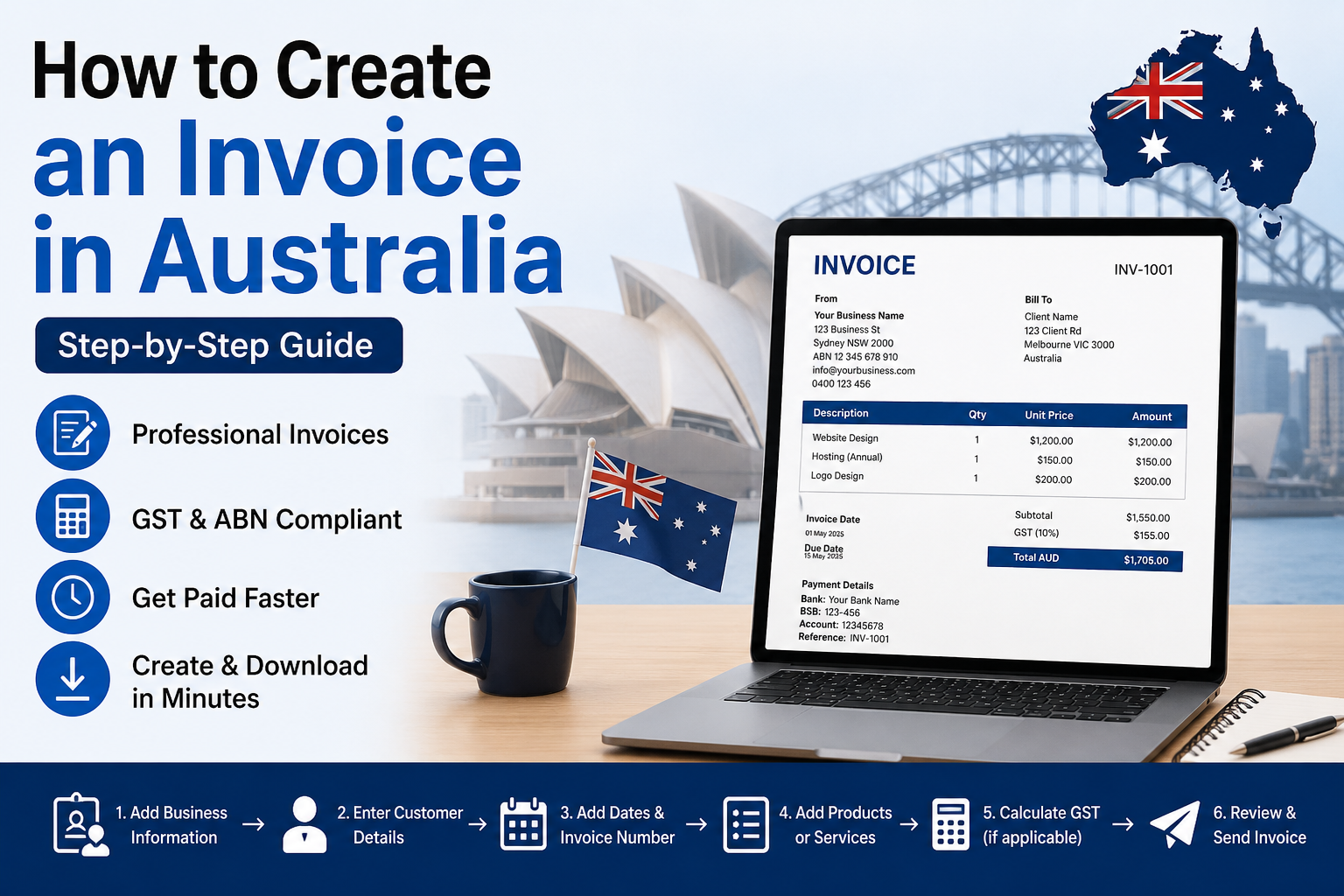
How to Create an Invoice in Australia (2026 Guide)
Learn how to create a professional invoice in Australia. Discover invoice requirements, GST, ABN details, payment terms, and use a free invoice generator.
GST Invoice Requirements for Indian Freelancers in 2026: The Complete Checklist
If your annual freelance income in India exceeds ₹20 lakh, GST registration is mandatory. But even below that threshold, corporate clients often demand a GSTIN before processing your invoice. Understanding what a compliant GST invoice must contain helps you avoid rejected payments and stay on the ri
Free Invoice Template in Excel: Download & Create Professional Invoices Easily
A free invoice template in Excel helps you create clean and professional invoices without any design skills. You can easily edit details like client name, services, price, and total amount. It’s simple, fast, and perfect for freelancers and small businesses who want an organized billing process.
Simple Invoice Format in Word (Free Template for Small Businesses)
Learn how to create a simple invoice format in Word with easy examples, essential invoice elements, and step-by-step guidance.