Canada GST/HST Invoice Requirements for Freelancers: The 2026 Compliance Guide
Do Canadian Freelancers Need to Charge GST/HST?
Not every Canadian freelancer needs to charge GST/HST. The first thing to check is whether you're registered or required to register for GST/HST.
For most freelancers, the key number is $30,000 in taxable supplies. If your worldwide taxable supplies are $30,000 or less in a single calendar quarter and over the previous four consecutive calendar quarters, you generally qualify as a small supplier and don't have to register. You can still choose to register voluntarily if you want to.
Things change when you go over that threshold. If you exceed $30,000 in taxable supplies during one calendar quarter, you generally have to register and start charging GST/HST on the supply that pushed you over the limit. If you cross the threshold over four consecutive quarters instead, different timing rules apply.
So don't look at another freelancer's invoice and assume you need to charge the same tax. Your sales, services, registration status, and client situation matter.
If you are registered, you'll need to follow the applicable GST/HST invoice requirements for freelancers and show the required tax information on your invoices.
Simple rule: check your GST/HST registration status first. Then decide what tax needs to appear on your invoice.
What Is a GST/HST Invoice?
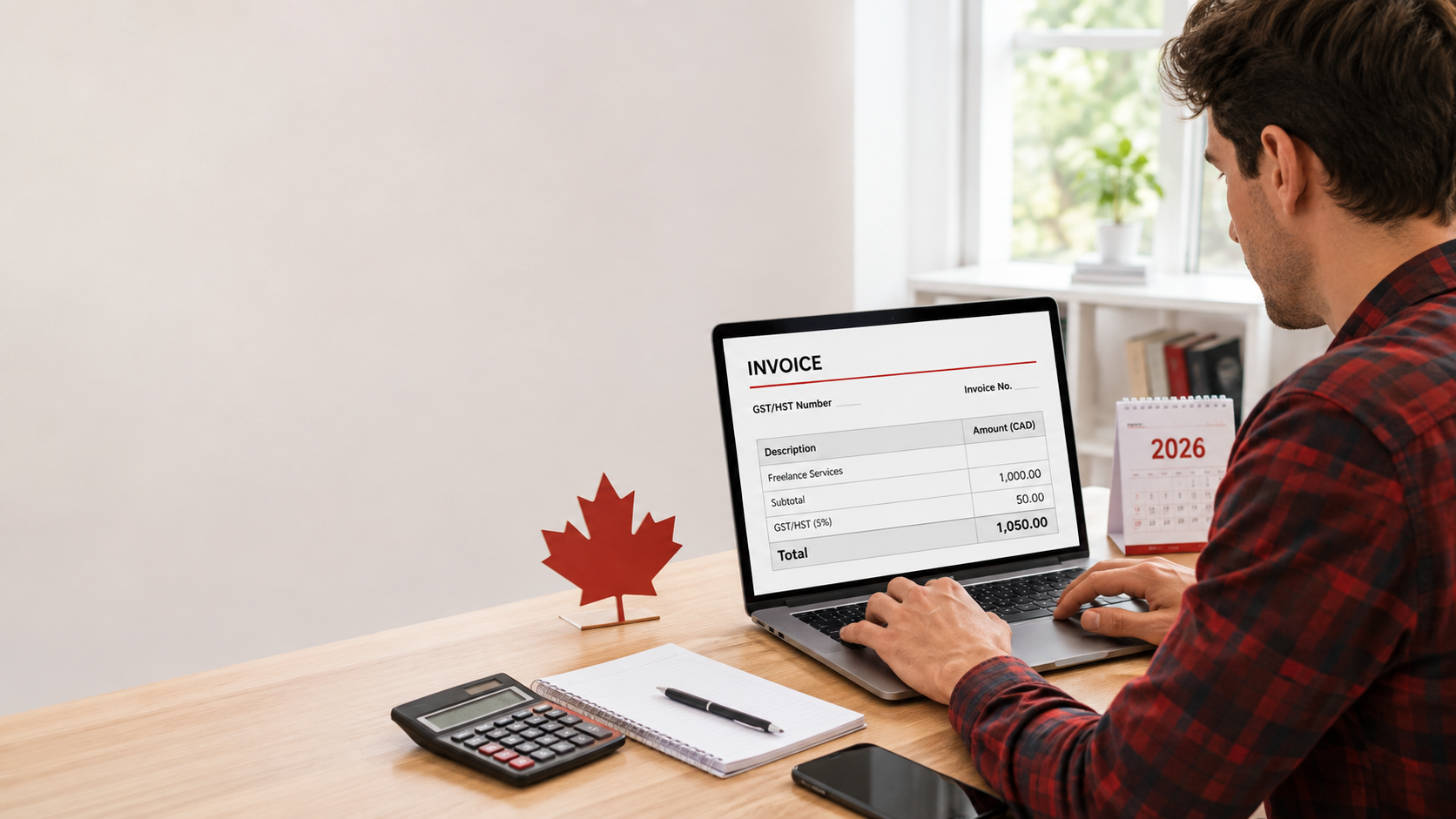
A GST/HST invoice is a bill that shows your client what service you provided, how much they owe, and how much GST/HST you're charging.
If you're registered for GST/HST, your invoice needs to include certain information so your client can understand the charge and, where applicable, use the invoice for their own GST/HST records.
For example, imagine you're a freelance web designer and charge a client CAD $2,000 for a website project. Your invoice would show the service, the amount before tax, the applicable GST/HST, and the final amount the client needs to pay.
A proper invoice can also include your business name, address, GST/HST registration number, invoice date, invoice number, and client details. The exact information required can depend on the transaction and the amount involved.
The important thing is not to make your invoice complicated. Follow the GST/HST invoice requirements in Canada, show the required information clearly, and make sure the tax amount is correct.
A clean invoice saves both you and your client from having to work out what the numbers mean later.
What Information Must Be on a Canadian GST/HST Invoice?
If you're registered for GST/HST, your invoice needs to give your client enough information to understand the transaction and, when applicable, support their GST/HST records.
Here are the main details to keep in your invoice checklist.
1. Your Name or Business Name
Start with the name you're using for your freelance business. Your client should be able to clearly identify who provided the service.
2. Your Business Address
Add your business address. This also makes it easier for your client to keep proper records.
3. Your GST/HST Registration Number
If you're registered, include your GST/HST account number when required. Check that the number is correct before sending the invoice.
4. Invoice Date
Clearly show the date the invoice was issued.
5. Invoice Number
Use a unique invoice number for each invoice. A simple system such as INV-2026-001, INV-2026-002, and so on can make your records much easier to manage.
6. Client Details
Include the client's name and enough information to identify who you're billing.
7. Description of Your Service
Be specific about what you did.
Instead of:
“Freelance services — $2,000”
write:
“Website design and development — $2,000”
Your client should be able to look at the invoice and immediately understand what they're paying for.
Ready to send your next invoice?
Create a professional invoice with Invoice Desire and make freelance billing simpler.
8. Amount Before GST/HST
Show the price of your service before tax.
9. GST/HST Rate
Show the applicable GST/HST rate for the transaction. Don't automatically use the rate from your own province without checking the rules that apply to the supply.
10. GST/HST Amount
Clearly show the amount of GST/HST charged.
11. Total Amount Due
Show the final amount, including tax, so your client knows exactly what to pay.
12. Payment Terms
Adding the payment due date and payment instructions makes the invoice more useful and can help avoid late-payment confusion.
These are the key GST/HST invoice requirements for freelancers, but the exact information required can vary depending on the transaction and invoice amount. The Canada Revenue Agency (CRA) has specific documentation rules, so check the current requirements when preparing your invoices.
GST vs HST: What's the Difference?
GST and HST are both forms of sales tax, but they aren't exactly the same thing.
GST stands for Goods and Services Tax. It's the federal sales tax that applies across Canada.
HST, or Harmonized Sales Tax, combines the federal GST with a provincial part of the sales tax. HST is used in certain provinces, so the rate you charge can depend on where the supply is considered to take place.
For a freelancer, this matters because you shouldn't simply choose GST or HST based on where you live. The tax treatment can depend on your client's location, the type of service you're providing, and the place-of-supply rules.
For example, a freelancer may charge a different tax rate on a service supplied to a client in another province than they would for a client in their own province.
That's why there's no single GST HST invoice Canada format that tells every freelancer exactly what rate to use. Your invoice should reflect the tax treatment that applies to that particular transaction.
If you're unsure which tax applies, check the current CRA guidance before sending the invoice. Getting the rate right is much better than having to correct the invoice later.
What GST/HST Rate Should a Freelancer Charge?
There's no single GST/HST rate that every Canadian freelancer should use. The correct rate depends on the type of supply and the place-of-supply rules that apply to your transaction.
For many taxable supplies, the federal GST rate is 5%. Some provinces use HST instead, and the HST rate varies by province. For example, Ontario's HST rate is 13%, while New Brunswick, Newfoundland and Labrador, Nova Scotia, and Prince Edward Island have different HST rates.
That's why you shouldn't simply look at where your home office is and add that tax rate to every invoice.
For example, if you're a freelancer in Ontario, you might be tempted to add 13% HST to every client invoice. That's not a safe approach. The correct treatment can depend on where your client is and what service you're supplying.
Before sending a GST/HST invoice for freelancers, check:
Where your client is locatedWhat service you're providingWhere the service is considered suppliedWhether any special place-of-supply rule appliesWhether you're registered for GST/HST
If you're unsure about the correct rate, check the latest CRA guidance rather than guessing. A wrong tax rate can mean you'll need to correct the invoice later.
GST/HST Registration for Freelancers
If you're a freelancer in Canada, you don't automatically have to register for GST/HST just because you earn money from freelance work. Your taxable revenue matters.
For most freelancers, the small-supplier threshold is $30,000. If your taxable supplies stay at or below that amount during the relevant period, you generally don't have to register. You can still choose to register voluntarily.
Things change when you go over the threshold. For example, if your taxable supplies exceed $30,000 in a single calendar quarter, you generally stop being a small supplier and need to register. There are also rules for when you cross the threshold over four consecutive calendar quarters.
Voluntary registration can have benefits, but it also means taking on GST/HST responsibilities. Once registered, you'll need to charge the applicable tax on taxable supplies, keep proper records, file GST/HST returns, and handle the tax you collect according to CRA rules.
So don't register just because another freelancer told you that you should. Look at your revenue, clients, and future plans first.
If you're registered, you'll also need to follow the relevant GST/HST invoice requirements for freelancers when billing your clients.
Simple GST/HST Invoice Example for a Canadian Freelancer
Let's make this easier with a real-world example.
Imagine you're a freelance graphic designer in Ontario and you've completed a branding project for a client. For this example, assume the applicable tax is 13% HST.
Your invoice could look like this:
GST/HST INVOICE
Freelancer: Maple Creative Studio
Address: Toronto, Ontario, Canada
GST/HST Account Number: 12345 6789 RT0001
Invoice No.: INV-2026-014
Invoice Date: August 21, 2026
Bill To: ABC Marketing Inc.
Service: Brand identity and logo design — CAD $2,000
Subtotal: CAD $2,000
HST @ 13%: CAD $260
Total Due: CAD $2,260
Payment Due: September 5, 2026
The business name, address, account number, and other details above are fictional examples. The tax rate is also being used only for this example.
Notice how the invoice makes the numbers easy to follow. Your client can see the service price, the HST amount, and the final amount without doing the calculation themselves.
When preparing a GST/HST invoice format for freelancers, don't worry about making it overly fancy. Keep the important information clear, use the correct tax treatment for the transaction, and make the amount due easy to spot.
Do You Charge GST/HST to Clients in Another Province?
Working with clients across Canada is normal for freelancers. The tricky part is that you shouldn't automatically use the GST/HST rate from your own province for every client.
For GST/HST, the place-of-supply rules help determine which tax treatment applies. The answer can depend on the type of service you're providing and where the client is located.
For example, imagine you're a freelance designer in Ontario and you work remotely for a business in Alberta. You shouldn't simply assume that because you're based in Ontario, you must charge Ontario's 13% HST. You need to check the rules for that particular service and transaction.
This is especially important if you work with clients in several provinces. Keep a record of where your clients are located and make sure your invoices use the correct tax treatment.
If you're unsure, don't guess. Check the current CRA guidance for the specific type of service you're providing.
When creating a GST/HST invoice in Canada, the client's location can matter just as much as your own location. That's why copying the same tax rate onto every invoice isn't a good idea.
Do You Charge GST/HST to Clients in Another Province?
Working with clients across Canada is normal for freelancers. The tricky part is that you shouldn't automatically use the GST/HST rate from your own province for every client.
For GST/HST, the place-of-supply rules help determine which tax treatment applies. The answer can depend on the type of service you're providing and where the client is located.
For example, imagine you're a freelance designer in Ontario and you work remotely for a business in Alberta. You shouldn't simply assume that because you're based in Ontario, you must charge Ontario's 13% HST. You need to check the rules for that particular service and transaction.
This is especially important if you work with clients in several provinces. Keep a record of where your clients are located and make sure your invoices use the correct tax treatment.
If you're unsure, don't guess. Check the current CRA guidance for the specific type of service you're providing.
When creating a GST/HST invoice in Canada, the client's location can matter just as much as your own location. That's why copying the same tax rate onto every invoice isn't a good idea.
What About Clients Outside Canada?
Working with clients outside Canada can make GST/HST a little more complicated. You shouldn't automatically assume that an international client means you don't charge GST/HST.
The tax treatment can depend on what service you're providing, who your client is, and where the service is considered to be supplied. Some services provided to clients outside Canada may qualify for zero-rating, but specific rules and exceptions can apply.
For example, if you're a Canadian freelance designer working for a business in the United States, the invoice may have different GST/HST treatment than an invoice for a Canadian client. But don't decide the tax rate based only on the client's country.
Before sending an international invoice, check:
Where your client is locatedWhether the client is a business or individualWhat service you're providingWhether the service can be zero-ratedWhether any special place-of-supply rule applies
If GST/HST doesn't apply to a particular transaction, don't simply write “No GST because the client is foreign.” Keep the reason and supporting records clear.
For GST/HST invoice requirements for freelancers, international clients are one area where checking the current CRA rules is especially important. If you're unsure about a specific transaction, get professional tax advice rather than guessing.
Common GST/HST Invoice Mistakes Freelancers Make
Most invoice mistakes aren't complicated. They're usually small details that get missed when you're in a hurry to send the invoice.
Here are some common ones to watch for:
Using the Wrong GST/HST Rate
Don't copy the tax rate from your last invoice without checking whether it applies to the new client and service.
Entering the Wrong GST/HST Number
If you're registered, check your GST/HST account number before sending the invoice. One incorrect digit can cause problems for your records or your client's records.
Forgetting the Invoice Number
Give every invoice a clear, unique number. This makes it much easier to track payments and find an invoice later.
Using a Vague Service Description
“Freelance work” isn't very helpful. Say what you actually did, such as “5-page website design” or “Monthly SEO services.”
Adding GST/HST When You Shouldn't
Don't charge GST/HST simply because you're running a freelance business. Your registration status and the transaction determine whether you should charge it.
Forgetting the Tax Amount
If GST/HST applies, make the tax amount clear on the invoice instead of hiding it inside the total.
Not Checking the Client's Details
A wrong company name or address can make an otherwise good invoice look careless.
Sending an Invoice Without Checking the Total
Before you click send, check the subtotal, tax, and final amount. A quick review can save you from sending a corrected invoice later.
These simple checks cover many of the common GST/HST invoice requirements for freelancers and can make your invoicing much easier to manage.
GST/HST Invoice Checklist Before Sending
Before sending a GST/HST invoice to your client, take a minute to check the important details. This simple checklist can help you catch mistakes before the invoice leaves your inbox.
Quick Checklist
☐ Your name or business name is correct
☐ Your business address is included
☐ Your GST/HST account number is correct, if applicable
☐ The invoice number is unique
☐ The invoice date is correct
☐ The client's name and details are correct
☐ The service description clearly explains the work
☐ The amount before tax is correct
☐ You've used the correct GST/HST treatment
☐ The tax amount is calculated correctly
☐ The total amount due is correct
☐ Your payment terms are clear
☐ You've saved a copy for your records
Don't skip this check just because the invoice looks right. A wrong tax rate or account number can mean sending a corrected invoice later.
Use this GST/HST invoice checklist every time you bill a client, especially when you're working with clients in different provinces or outside Canada.
How to Create a GST/HST Invoice Online
Once you know what information belongs on your invoice, creating one online is pretty straightforward. You don't need to rebuild the same document in a spreadsheet every time a client asks for a bill.
Here's a simple process:
Add your business details — Enter your name, address, and GST/HST account number if you're registered.
Add your client's details — Include the client or business name and other required information.
Add invoice details — Give the invoice a unique number and add the invoice date.
Describe your service — Clearly explain what you're charging for.
Enter the amount — Add the price before tax.
Add the applicable GST/HST — Use the tax treatment that applies to your particular transaction.
Check the total — Make sure the subtotal, tax, and final amount are correct.
Add payment details — Tell your client how and when to pay.
Download the invoice — Save it as a PDF and send it to your client.
You can use an online GST HST invoice Canada tool to make this process faster and keep your invoices looking consistent.
Just remember that an invoice generator can create the document, but it can't replace your responsibility to use the correct tax rate and GST/HST treatment for your transaction.
Create Your Canadian Freelancer Invoice with Invoice Desire
Once you've figured out the GST/HST details, the actual invoice shouldn't take much time. That's where a simple invoice tool can help.
With Invoice Desire, you can create a clean professional invoice by adding your business details, client information, services, amounts, and applicable tax details. You can review everything before downloading the invoice as a PDF and sending it to your client.
It's useful when you're handling several clients and don't want to create a new invoice layout every time.
Just keep one thing in mind: an invoice generator helps you prepare the document, but you still need to make sure the tax rate, GST/HST treatment, and business information are correct for your transaction.
Frequently Asked Questions
Do Canadian freelancers need to charge GST/HST?
Not always. It generally depends on whether you're registered or required to register for GST/HST. The $30,000 small-supplier threshold is an important starting point for many freelancers.
What information should be on a GST/HST invoice?
Depending on the transaction and invoice amount, required details can include your business name, GST/HST account number, invoice date, invoice number, client information, description of the service, amount charged, and GST/HST details.
What GST/HST rate should a freelancer charge?
There's no single rate for every freelancer. The applicable rate depends on the type of supply and the place-of-supply rules. Don't automatically use the rate from your own province for every client.
Do I charge GST/HST to a client in another province?
It depends on the service and the applicable place-of-supply rules. Your client's province can affect the GST/HST treatment, so check the rules before using your usual tax rate.
Do I charge GST/HST to clients outside Canada?
Not necessarily. Some supplies to clients outside Canada may qualify for zero-rating, but specific conditions apply. Don't assume that every foreign-client invoice automatically has no GST/HST.
Can a freelancer voluntarily register for GST/HST?
Yes, a freelancer who isn't required to register may be able to register voluntarily. However, registration also comes with GST/HST responsibilities, so consider the pros and obligations before registering.
Can I create a GST/HST invoice online?
Yes. You can use an online invoice generator to create, check, and download your invoice. You still need to make sure the tax treatment and information on the invoice are correct.
What's the easiest way to avoid GST/HST invoice mistakes?
Use a checklist before sending every invoice. Check your GST/HST account number, invoice number, client details, service description, tax treatment, tax amount, and final total. A one-minute review can save you from correcting an invoice later.
Conclusion
GST/HST invoicing doesn't have to be complicated. The important part is knowing when you need to charge GST/HST and making sure your invoice includes the right information.
If you're a Canadian freelancer, don't copy another freelancer's tax rate or invoice format without checking your own situation. Your registration status, type of service, client location, and place-of-supply rules can all affect how you invoice.
Before sending your next invoice, check your GST/HST number, invoice number, client details, service description, tax rate, tax amount, and final total. That quick check can prevent a lot of unnecessary corrections.
And if you're ready to make invoicing easier, Invoice Desire can help you create clean, professional invoices and download them as PDFs.
Create your next invoice with Invoice Desire and spend less time formatting invoices and more time doing your actual freelance work.
Found this helpful?
Share it with a fellow freelancer or business owner.
Keep reading
Packing Slip vs Invoice vs Delivery Note: What's the Difference?
Learn the difference between a packing slip, invoice, and delivery note, what each document is used for, what to include, and when you need them.

Recurring Invoices and Retainer Billing for Freelancers: A Complete 2026 Guide
For freelancers chasing stable, predictable income, retainer agreements are the gold standard — and the recurring invoice is the tool that makes them work. Instead of starting each month hunting new projects, retainer clients provide guaranteed work and guaranteed pay. But billing for a retainer cor

Why Your Invoicing Tool's Privacy Policy Is a GDPR Risk You Haven't Considered
Most freelancers choose an invoicing tool based on price or ease of use. Very few ask the more important question: where does my client data actually go? In 2026, with GDPR enforcement at record levels and data breaches increasingly targeting small businesses, the answer has real consequences.

France E-Invoicing Mandate September 2026: What Every Freelancer Must Do Now
France's long-anticipated e-invoicing mandate goes live on 1 September 2026. While large enterprises have been preparing for months, many independent freelancers and auto-entrepreneurs remain unaware that they will be affected—and that the deadline to receive structured e-invoices is just weeks away

Poland's KSeF Mandatory E-Invoicing in 2026: A Freelancer's Compliance Guide
Poland became one of the first EU countries to enforce mandatory B2B e-invoicing in 2026 through its Krajowy System e-Faktur (KSeF) platform. If you are a freelancer or sole trader doing business in Poland — or invoicing Polish clients in a B2B context — understanding KSeF is now a compliance requir

Belgium's B2B E-Invoicing Mandate in 2026: A Freelancer's Essential Compliance Guide
On 1 January 2026, Belgium became one of the first EU countries to mandate structured e-invoicing for all B2B transactions between VAT-registered businesses. If you are a freelancer working with Belgian business clients, your plain PDF invoice may no longer be legally sufficient.