How to Calculate GST in Invoice (With Simple Examples)
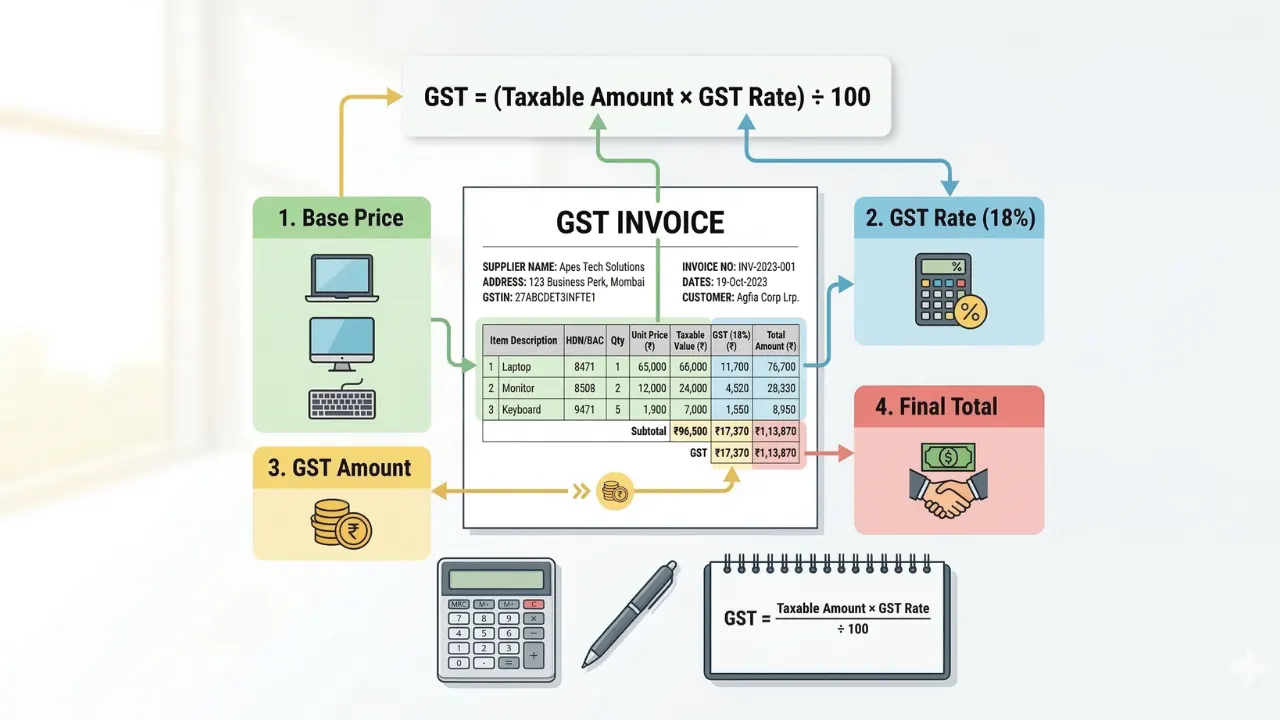
Sending correct invoices is just as crucial to operating a business as providing excellent goods or services. Knowing how to accurately calculate GST on an invoice is a crucial step in this process. The base price of goods or services must be increased by GST (Goods and Services Tax), and even a tiny computation error can cause confusion for both the company and the client.
Accurate GST computation guarantees openness, encourages client trust, and maintains all of your financial records. Additionally, it assists companies in following to tax laws. It is much simpler to create professional and error-free invoices when you understand how to calculate gst in invoice.
What Is GST?
The majority of goods and services sold in many nations, including India, are subject to the Goods and Services Tax, or GST. GST simplifies taxation for both customers and businesses by combining various indirect taxes into an integrated whole.
GST is added to the base price and displayed on the invoice whenever a company sells a good or service. The customer is then required to pay this tax, which is then given to the government. Anyone who creates invoices should understand GST because it has a direct impact on the total amount billed. Businesses can charge the appropriate tax and keep accurate financial records by learning how to calculate GST on invoices.
What Is a GST Invoice?
When a company sells goods or services that include Goods and Services Tax, it sends the customer a document known as a GST invoice. This displays all of the transaction's information, such as the cost of the good or service, the applicable GST rate, and the total sum that the client must pay.
A GST invoice, in contrast to a standard invoice, clearly shows the tax destruction, such as CGST, SGST, or IGST, according to the type of the transaction. Important data like the company name, GST number, invoice number, date, and client details are also included.
A proper GST invoice guarantees accurate tax calculations and aids in the maintenance of transparent financial records for businesses. This is why it's crucial to understand how to calculate GST in invoice. Both the company and the client are able to understand the final billing amount when GST is accurately added and displayed.
Create GST Invoices Instantly
Stop calculating GST manually and avoid mistakes in your invoices. Use InvoiceDesire to automatically calculate GST, generate professional invoices, and keep your billing process simple and accurate.
Basic Components of a GST Invoice
A correct GST invoice contains a number of crucial details that make the transaction easy to understand for both the client and the company. It is simpler to arrange these elements and present them professionally when you understand how to calculate GST in invoice. Accurately displaying the price, tax, and total amount depends on each section of the invoice.
1. Business Data
The seller's company name should be included at the top of the document. The company name, location, phone number, and GSTIN (GST Identification Number) usually appears in this. These specifics help keep current tax records and show who has sent the invoice.
2. Client Data
The customer's name, address, and phone number must then be on an invoice. The client's GSTIN may also be included if they are registered for GST. This section makes it easier to see to whom the invoice is addressed.
3. Details of the Invoice
The date of the granting and an individual invoice number must be included for each GST invoice. Businesses can keep orderly financial records and track payments with the help of these details. When handling several transactions, a distinct invoice number also helps to avoid confusion.
4. Description of the Good or Service
The products or services offered to the client are listed in this section. A short outline, quantity, and the cost should be included for each item. The customer can better comprehend what they are being charged for with clear descriptions.
5. GST Division
The tax breakdown is one of the invoice's most essential sections. In this case, the base price is subject to the applicable GST rate. The invoice may display IGST for interstate sales or CGST and SGST for intra-state sales, depending on the type of transaction.
6. Total Amount Due
Lastly, the total amount that the customer must pay should be displayed on the invoice. This includes the GST amount in addition to the base price. Businesses can clearly display this final amount and prevent billing errors when they know how to calculate GST in invoices.
GST Rates Businesses Should Know
Companies need to be aware of the common GST rates that apply to different kinds of products and services before creating an invoice. GST typically falls to one of four primary groups: 5%, 12%, 18%, or 28%. The kind of good or service being sold decides the price. For instance, luxury goods might be subject to higher tax brackets, whereas necessities might have a lower GST rate.
While learning how to calculate GST in invoice, you need to know the right rate because using the incorrect percentage can result in incorrect billing. To guarantee accurate tax calculation, businesses should always verify the correct GST rate before including it to an invoice.
Formula: How to Calculate GST in Invoice
After you understand the basic formula, learning how to calculate GST in invoice is quite simple. Find the product or service's initial cost first. Next, figure the tax sum using the GST rate.
GST Amount = (Original Price × GST Rate) ÷ 100 is the basic formula.
As an example, if the GST rate is 18% and a product costs ₹1,000, the GST amount will be ₹180. After including the tax, the total price of the invoice would be ₹1,180.
Must specify the base cost, GST rate, tax value, and ultimate total when creating an invoice. This keeps the reliability of your financial records while helping customers in understanding the billing.
A clear invoice with the correct GST calculation builds trust and keeps your business financially organized.
Example 1: Simple GST Calculation
When GST is reduced to a simple formula, knowing how to calculate GST in invoice becomes much simpler. Businesses typically compute GST as a percentage of the cost of goods or services.
The simple formula is:
GST Amount = (Original Price × GST Rate) ÷ 100
For example, if the GST rate is 18% and you sell a service for ₹1,000, the calculation would be:
GST = (1000 × 18) × 100 = ₹180
Thus, the total of the final invoice is:
₹1,000 + ₹180 = ₹1,180
In order intra-state business transactions, GST usually gets split into CGST and SGST in India. In this case, the 18% GST will be split among 9% CGST and 9% SGST. The whole 18% is charged as IGST in the event of an interstate sale.
Example 2: GST Calculation for Products
To better understand how to calculate GST in invoice, let’s look at a simple example involving a product sale.
Imagine you run a small electronics shop and sell a pair of headphones for ₹2,500. Suppose the GST rate for this product category is 18%. To calculate GST, you apply the formula:
GST Amount = (Product Price × GST Rate) ÷ 100
So the calculation would be:
GST = (2,500 × 18) ÷ 100 = ₹450
Now add the GST amount to the product price:
Final Invoice Amount = ₹2,500 + ₹450 = ₹2,950
If the sale happens within the same state, the 18% GST is split into 9% CGST and 9% SGST. That means ₹225 will be CGST and ₹225 will be SGST. For interstate sales, the entire 18% is charged as IGST.
Including this breakdown in your invoice makes pricing transparent and helps clients clearly understand how to calculate GST in invoice for products.
CGST, SGST, and IGST Explained
It's essential to fully understand the three GST types when learning how to calculate GST in invoice. When a sale takes place inside the same state, both SGST (State GST) and CGST (Central GST) are applied. IGST (Integrated GST) is applied to sales made across state lines. The correct allocation of taxes between both the state and the federal governments is ensured by this system.
Step-by-Step: How to Calculate GST in Invoice
Learning how to calculate GST in invoice may at first appear confusing if you're new to GST billing. However, it becomes very easy if you follow a basic process.
Step 1: Find the GST Rate
First, find the right GST rate for the good or service you offer for sale. The usual GST rates in India are 5%, 12%, 18%, and 28%.
Step 2: Find the Initial Price
Next, record the product or service's initial price before GST is applied. We refer to this sum as the taxable value.
Step 3: Determine the GST Amount
Apply this straightforward formula:
GST Amount = (Taxable Value × GST Rate) ÷ 100
Step 4: Increase the Base Price by GST
Lastly, to determine the total invoice value, add the GST amount to the initial price.
Conclusion
For any business owner or freelancer, understanding how to calculate GST in invoice is important. Invoices become clearer and expert when you compute tax properly and use the right GST rate. An invoice generator may speed up the procedure, cut down on mistakes, and make it easier for you to produce GST-compliant invoices.
Found this helpful?
Share it with a fellow freelancer or business owner.
Keep reading
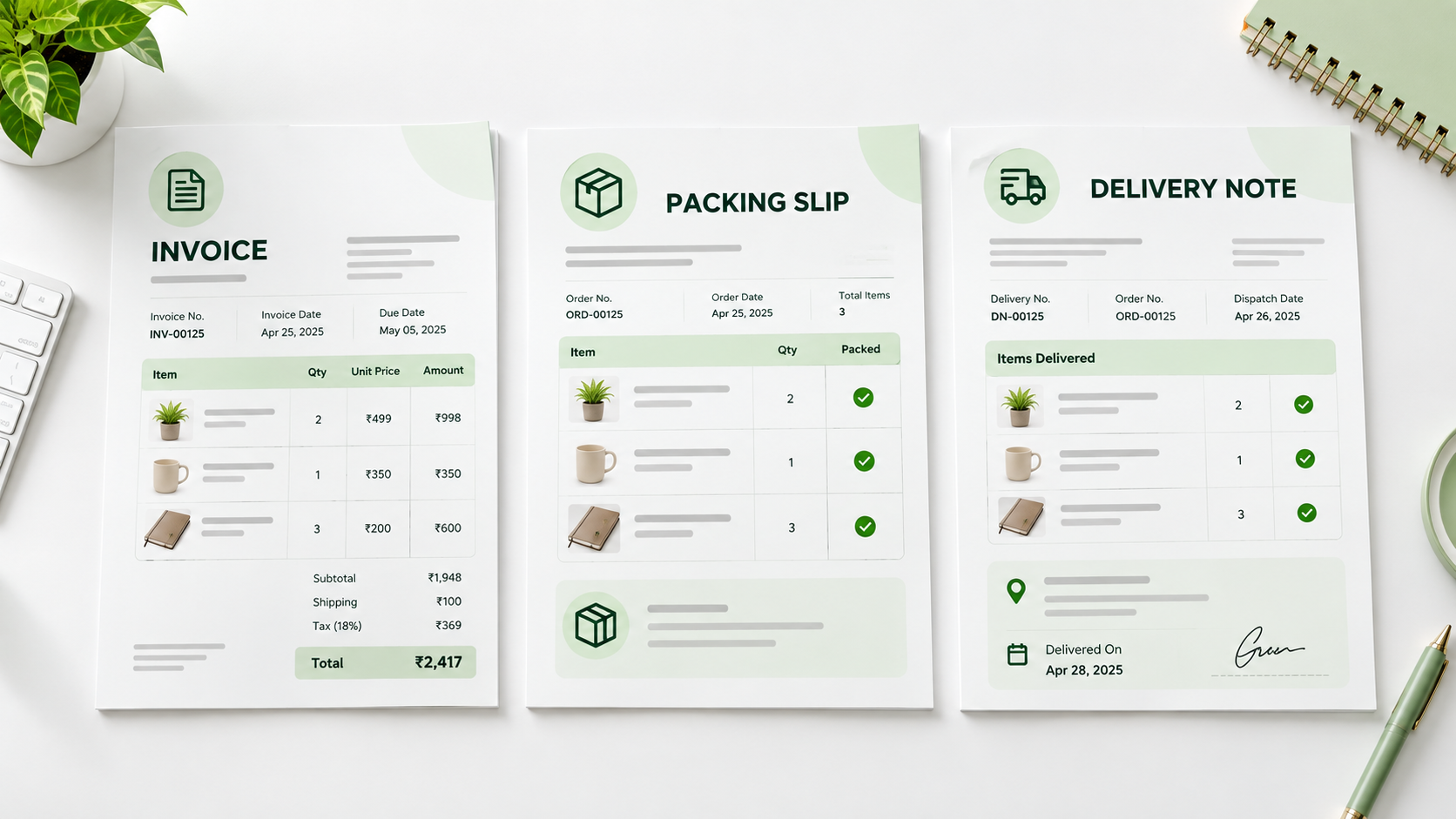
Packing Slip vs Invoice vs Delivery Note: What's the Difference?
Learn the difference between a packing slip, invoice, and delivery note, what each document is used for, what to include, and when you need them.

Recurring Invoices and Retainer Billing for Freelancers: A Complete 2026 Guide
For freelancers chasing stable, predictable income, retainer agreements are the gold standard — and the recurring invoice is the tool that makes them work. Instead of starting each month hunting new projects, retainer clients provide guaranteed work and guaranteed pay. But billing for a retainer cor

Why Your Invoicing Tool's Privacy Policy Is a GDPR Risk You Haven't Considered
Most freelancers choose an invoicing tool based on price or ease of use. Very few ask the more important question: where does my client data actually go? In 2026, with GDPR enforcement at record levels and data breaches increasingly targeting small businesses, the answer has real consequences.

France E-Invoicing Mandate September 2026: What Every Freelancer Must Do Now
France's long-anticipated e-invoicing mandate goes live on 1 September 2026. While large enterprises have been preparing for months, many independent freelancers and auto-entrepreneurs remain unaware that they will be affected—and that the deadline to receive structured e-invoices is just weeks away

Poland's KSeF Mandatory E-Invoicing in 2026: A Freelancer's Compliance Guide
Poland became one of the first EU countries to enforce mandatory B2B e-invoicing in 2026 through its Krajowy System e-Faktur (KSeF) platform. If you are a freelancer or sole trader doing business in Poland — or invoicing Polish clients in a B2B context — understanding KSeF is now a compliance requir

Digital Nomad Invoicing in 2026: How to Bill Clients Across Borders Without a Tax Headache
If you work as a digital nomad — billing London clients from Bali or invoicing New York businesses from Lisbon — the rules that govern what goes on your invoice are determined by your client's location, not yours. In 2026, cross-border tax authority data sharing has intensified and several major eco